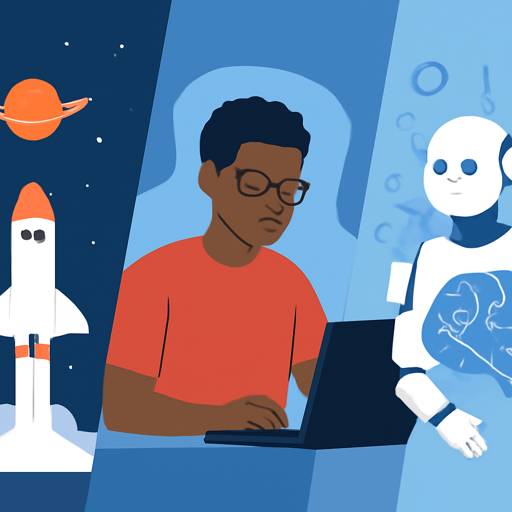
The most exciting breakthroughs in modern STEM sit at the intersections: the night sky linking to data science, psychology meeting computer models, and robots learning to collaborate like living organisms. Whether the goal is a science fair, a classroom capstone, or an independent portfolio, a strategic mix of astronomy research ideas, cognitive science for high school, and hands-on robotics yields deep learning and standout results. By grounding projects in authentic questions, open datasets, and repeatable methods, learners develop the creative resilience and technical fluency that universities and future employers value. The following sections outline project paths, tools, and case-ready concepts that connect curiosity to evidence, and imagination to working prototypes.
Hands-On Space Science: Astronomy Research Ideas and Space Telescope Projects
Space is both vast and accessible when students start with well-scoped questions and public data. Powerful astronomy research ideas include measuring exoplanet transits using archival light curves, tracking variable stars with inexpensive cameras, or mapping light pollution to understand environmental change. Public missions—Hubble, TESS, Kepler, and JWST—offer science-grade archives; with Python, pandas, and AstroPy, learners can filter, clean, and visualize observations like practicing astronomers. Even better, many targets have incomplete catalogs, turning a classroom exercise into a genuine contribution to the field.
For hardware-driven projects, a DSLR or mirrorless camera on a stable mount can produce surprisingly precise photometry when paired with free software such as AstroImageJ. A simple transmission grating turns that camera into a beginner spectrograph for studying stellar composition. Schools with radio interests can explore 21-cm hydrogen line detection using a small radio dish, SDR (software-defined radio), and GNU Radio, bridging physics, signal processing, and cosmology. These projects emulate the spirit of Space Telescope Projects by emphasizing careful calibration—bias, dark, and flat frames—and repeatability.
Case example: A team identifies a TESS Object of Interest, downloads light curves, and writes a script to remove systematics, then fits a transit model to estimate planet size. The same team can cross-check literature values to validate results and write a short paper. Another group compares sky brightness across neighborhoods using a standardized method (e.g., Sky Quality Meter or calibrated camera exposures), correlates results with municipal lighting data, and proposes local policy recommendations. In each case, students move beyond “pretty pictures” to data-driven narratives.
To elevate rigor, encourage pre-registration of hypotheses and a clear pipeline: define the objective, list assumptions, select datasets, document processing steps, quantify uncertainty, and interpret findings within known limitations. Introduce version control (Git) to track analysis and ensure reproducibility. When learners treat their work like a small mission—clear roles, schedules, risk logs—their outcomes mirror professional Space Telescope Projects while staying feasible with school resources.
Mapping the Mind: Cognitive Science for High School Innovators
Understanding how people think, learn, and decide delivers immediate relevance to school life and powerful material for research portfolios. With cognitive science for high school, students can design controlled experiments around memory, attention, bias, and perception—using tools that are free, ethical, and statistically grounded. Classic studies like the Stroop effect, the attentional blink, or change blindness adapt well to laptop-based experiments implemented in PsychoPy, jsPsych, or Python with simple GUI libraries. The key is robust design: randomized trials, counterbalancing conditions, sufficient sample size, and pre-defined analysis plans.
Example projects include testing how sleep quality relates to working memory scores using digit span tasks; comparing spaced versus massed practice on vocabulary retention; or measuring the impact of background music tempo on reading comprehension. With parental consent and privacy safeguards, students can anonymize data and store it securely, then analyze results using t-tests or ANOVA in Python or R. Elevating credibility means reporting effect sizes, confidence intervals, and potential confounds—not just p-values.
Beyond behavior, low-cost biosensing expands horizons. Consumer-grade EEG kits (e.g., OpenBCI), galvanic skin response sensors, or heart-rate variability monitors let students link physiology to cognitive load or stress. A lab might measure the effect of mindfulness breaks on task performance, correlating reaction times with EEG band power. Another team could develop a small app that nudges users toward spaced rehearsal, logs engagement, and compares learning outcomes to a control group. These designs reinforce ethical literacy: informed consent, de-identified storage, and transparency about limitations.
Real-world relevance is everywhere. User-experience researchers evaluate attention, advertisers study memory, and educators test retrieval practice. Students who frame projects with construct validity (does the test measure what it claims?) and ecological validity (does it generalize to real life?) learn to translate data into actionable insights. Integrating a simple computational model—like a reinforcement learning agent mimicking habit formation—adds depth, tying psychological theory to algorithms. When cognitive science for high school emphasizes rigorous measurement, clear reporting, and replicable code, learners produce research that stands up to scrutiny and directly improves how peers learn.
Building Tomorrow’s Machines: Humanoid and Swarm Robotics for Students
Robotics blends mechanics, electronics, and code into living lessons about feedback, control, and resilience. Starting with humanoid robotics for students, a bipedal platform teaches center-of-mass control, inverse kinematics, and gait planning. Students can begin with 9–12 servo legs and a microcontroller, then graduate to ROS 2 for sensor fusion and high-level behaviors. Simulators like Gazebo or Webots allow rapid iteration before printing or machining parts, while inexpensive IMUs and foot sensors close the loop for balance. The learning arc moves from open-loop “canned” motions to model-predictive control and compliant actuation that tolerates disturbances.
Case example: A team builds a 3D-printed biped with off-the-shelf servos and uses an extended Kalman filter to estimate tilt from an IMU. They implement zero-moment-point criteria for stable steps, logging fall events and recovery strategies. Another group adds vision with an OpenMV camera to detect colored markers, integrating a finite-state machine that sequences search, approach, and grasp with a parallel gripper. These efforts mirror industry: robust perception, modular control, and careful power management to avoid brownouts and overheating.
At the collective scale, Swarm robotics student projects bring algorithms to life through large numbers of simple robots collaborating toward a goal. Formation control, coverage, foraging, and flocking behaviors illustrate how local rules yield global order. Students can start with palm-sized bots or differential-drive rovers using BLE, Zigbee, or Wi-Fi for communication. They implement Boids-style steering—separation, alignment, cohesion—and compare emergent patterns under packet loss or range limits. Performance metrics include scalability (how performance changes with more robots), robustness (graceful degradation with failures), and latency tolerance.
Applied scenarios emphasize impact. Drones running decentralized search patterns can accelerate disaster response simulations, while ground swarms map crop health using distributed sensing. Warehouse-style coordination tasks—like dynamic task allocation based on battery levels and queue length—connect to operations research. Embedding consensus protocols (Vicsek model, average consensus) and collision-avoidance (ORCA) encourages mathematically grounded design, while Monte Carlo simulations quantify risk before deploying hardware. For guidance, curated repositories and tutorials on Swarm robotics student projects help teams benchmark against proven approaches and avoid common pitfalls as they iterate from simulation to field tests.
Integrating both worlds—humanoids and swarms—reveals rich synergies. Imagine a humanoid acting as a supervisor, visualizing swarm states on a handheld display and issuing high-level goals, while the swarm handles coverage and transport. This division of labor introduces task hierarchies, human-robot interaction, and multi-agent planning. Students gain fluency in ROS 2 for distributed messaging, MQTT for lightweight communication, and containerized deployment to manage dependencies across fleets. Charging docks, watchdog timers, and health diagnostics complete the professional workflow, preparing teams to scale from classroom prototypes to competition-ready systems.
You may also like
Choco Chip Cookies: Weich, gefüllt und intensiv schokoladig – so werden sie zum Lieblingssnack
The UK Steroids Landscape: Quality Signals, Legal Nuances, and Safer Decision-Making
Divorce in Boca Raton: Legal Strategy, Asset Protection, and Family Stability